Your School Can Be Involved In Using A Weather Station
One of the best ways to spark a student’s interest in science is by allowing them to collect and analyze real-world weather data.
A school weather station turns everyday weather into an interactive classroom experience where students can observe changing conditions, make predictions, and learn how meteorologists gather information.
Over the years, several organizations have helped schools add weather stations to their campuses.
Two of the most well-known initiatives have been the WeatherBug Schools Program and the Raspberry Pi Weather Station Project.
Although these programs have evolved, they continue to demonstrate the value of weather stations in education.

Why Every School Can Benefit From a Weather Station
A weather station is much more than a collection of sensors mounted on a rooftop.
It becomes a living science laboratory.
Students can observe weather conditions every day while learning about:
- Temperature
- Humidity
- Wind speed
- Wind direction
- Rainfall
- Barometric pressure
- Dew point
- Air pressure trends
Instead of reading numbers from a textbook, students are collecting information from instruments located at their own school.
This practical approach makes science more engaging and helps students better understand meteorology, climate, mathematics, and environmental science.
The WeatherBug Schools Program


For many years, the WeatherBug Schools Program has worked with schools across the United States.
It encourages them to install professional-quality weather stations on campus.
WeatherBug combines classroom lesson plans with live weather data. This data comes directly from participating schools.
Students can compare their school’s weather with conditions elsewhere. They can check thousands of other reporting locations.

- Kit represents the three core components of weather measurement: wind speed, wind direction and rainfall.
- It uses sealed magnetic reed switches and magnets so you'll need to source a voltage to take any measurements.
- All of the sensors in the weather meter kit are passive components. This means you will need a voltage source in order to measure anything with them.
WeatherBug says its educational network helps students understand weather better.
It does this by bringing real-time observations into classroom activities.
One of the most exciting features is the network itself. Participating schools become part of something much larger.
Students can see how their own weather data helps with forecasting. It also supports scientific research.
The Raspberry Pi Weather Station Project


Back in 2016, the Raspberry Pi Foundation partnered with Oracle to launch an educational weather station project for schools.
The program initially distributed approximately 1,000 climate station kits to selected schools around the world.
Each kit allowed students to build their own weather station using a Raspberry Pi computer while storing weather observations in a cloud-hosted database.
The project introduced students to several important STEM skills, including:
- Computer programming
- Electronics
- Sensor technology
- Environmental science
- Data analysis
- Cloud computing
Although the original rollout was limited, the project inspired many schools, makers, and hobbyists to build their own Raspberry Pi weather stations.
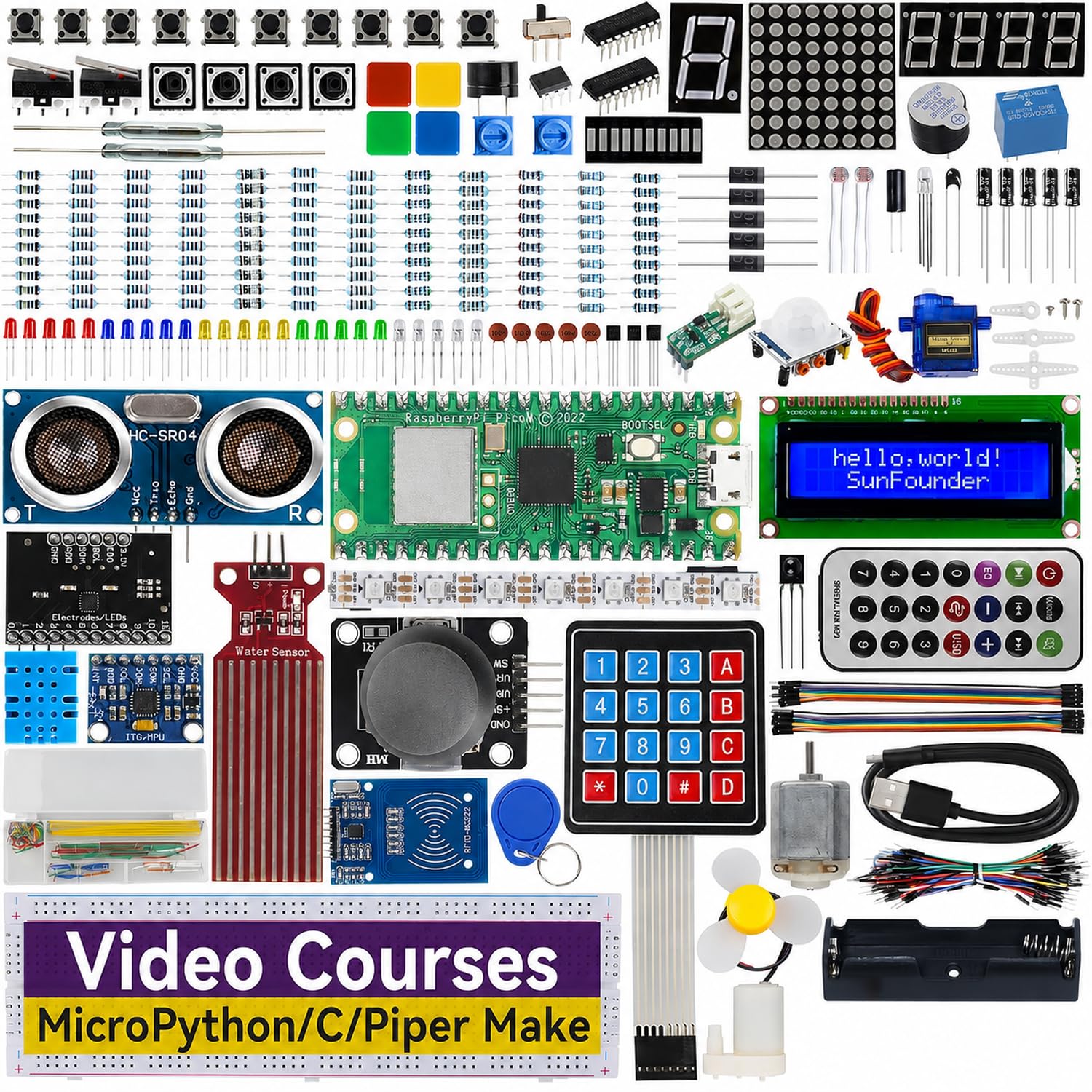
- IoT Starter Kit for Beginners: The SunFounder Raspberry Pi Pico W Ultimate Starter Kit offers a rich IoT learning experience for beginners aged 8+. With 450+ components, 117 projects, and expert-led video lessons, this kit makes learning microcontroller programming and IoT engaging and accessible, RoHS Compliant
- Expert-Guided Video Lessons: This kit includes 27 video tutorials by the renowned educator, Paul McWhorter. His engaging style simplifies complex concepts, ensuring an effective learning experience in microcontroller programming
- Wide Range of Hardware: The kit includes a diverse array of components like sensors, actuators, LEDs, LCDs, and more, enabling you to experiment and create a variety of projects with the Raspberry Pi Pico W
Today, the Raspberry Pi Foundation still provides extensive documentation and community resources for anyone interested in creating a weather station using Raspberry Pi hardware.
Learning Through Real Weather Data
One of the greatest advantages of a school weather station is that students collect authentic weather observations every day.
Instead of relying on sample data, students can:
- Track weather patterns
- Measure rainfall
- Compare seasonal changes
- Study wind direction
- Record temperature trends
- Graph historical weather data
- Make weather forecasts
This type of project naturally combines science, technology, engineering, and mathematics into one exciting learning experience.
Many students remember these activities long after they leave the classroom because they are actively participating rather than simply reading about the weather.
Weather Instruments Students Love to Use
Children are naturally curious about weather instruments.
Some of the most popular pieces of equipment include:
- Anemometer – measures wind speed
- Wind vane – shows wind direction
- Rain gauge – records rainfall
- Thermometer – measures temperature
- Hygrometer – measures humidity
- Barometer – measures atmospheric pressure
Watching these instruments respond to changing weather helps students understand concepts that might otherwise seem abstract.
Becoming Part of a Weather Observation Network
Many school weather stations automatically upload their observations to online weather networks.
This allows students to see their school’s data alongside readings from thousands of other locations.
Some educational weather networks also archive years of historical weather information, allowing students to study long-term weather patterns and climate trends.
- IoT Starter Kit for Beginners: The SunFounder Raspberry Pi Pico W Ultimate Starter Kit offers a rich IoT learning experience for beginners aged 8+. With 450+ components, 117 projects, and expert-led video lessons, this kit makes learning microcontroller programming and IoT engaging and accessible, RoHS Compliant
- Expert-Guided Video Lessons: This kit includes 27 video tutorials by the renowned educator, Paul McWhorter. His engaging style simplifies complex concepts, ensuring an effective learning experience in microcontroller programming
- Wide Range of Hardware: The kit includes a diverse array of components like sensors, actuators, LEDs, LCDs, and more, enabling you to experiment and create a variety of projects with the Raspberry Pi Pico W
Participating in a larger network also demonstrates how thousands of individual weather stations work together to improve weather forecasting around the world.
A Great STEM Project for Schools
Installing a weather station is an excellent way to introduce students to STEM education.
Students gain experience with:
- Scientific observation
- Data collection
- Computer technology
- Critical thinking
- Problem solving
- Weather forecasting
- Environmental awareness
Teachers often discover that weather becomes one of the most engaging science topics because students can immediately connect what they learn in class with the weather outside their classroom windows.
Final Thoughts
Whether a school chooses a commercial weather station, joins an educational weather network, or builds a Raspberry Pi weather station from scratch, students gain valuable hands-on experience that textbooks alone cannot provide.
Projects like the WeatherBug Schools Program and the Raspberry Pi Weather Station initiative have shown just how powerful experiential learning can be.
By collecting real weather data and participating in broader observation networks, students develop scientific skills while gaining a deeper appreciation for the atmosphere around them.
A school weather station is more than just educational equipment—it is an investment in curiosity, discovery, and the next generation of scientists, engineers, and weather enthusiasts.
Read More About Weather & Your Kids-View Related Posts Below
 Instruments to Build a Weather Station for Kids
To build a weather station for kids you need a list of weather instruments. I go over such weather instruments, as a hygrometer, a weather vane, a rain gauge, a barometer, etc.
 Weather Stations For Kids-Your Ultimate Guide
This weather stations for kids guide is detailed with directions you can follow to set up an effective learning tool for your kids & weather.